

Venice - It was among medieval manuscripts and medicinal plant gardens hidden in a Swiss monastery that curator Hans Ulrich Obrist, artistic director of the Serpentine Galleries in London and one of the central figures in global contemporary art, unknowingly began building his professional career.
Even as a child, at the age of five, he visited the library of the Abbey of St. Gallen with his parents, a city with a strong monastic tradition and known for its handcrafted embroidery for brands like Chanel . "It was like traveling back in time," Obrist recalls in an interview with NeoFeed , describing his early contact with the documents, with the past still very much alive in his memory.
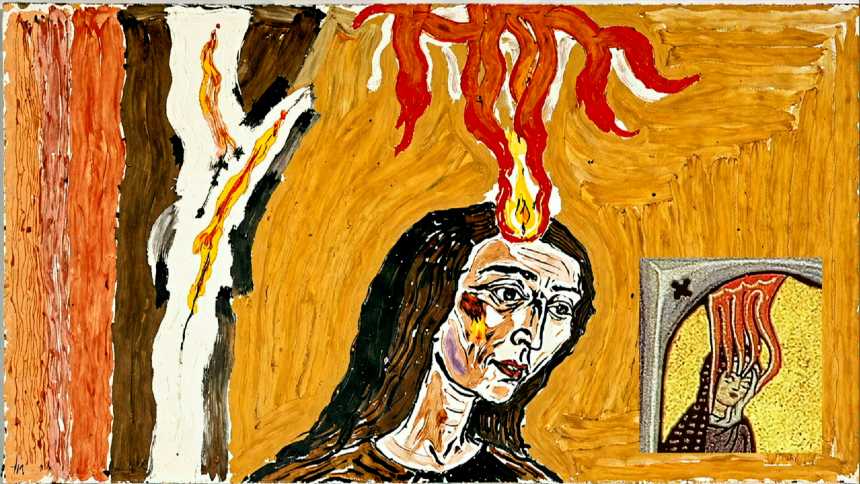
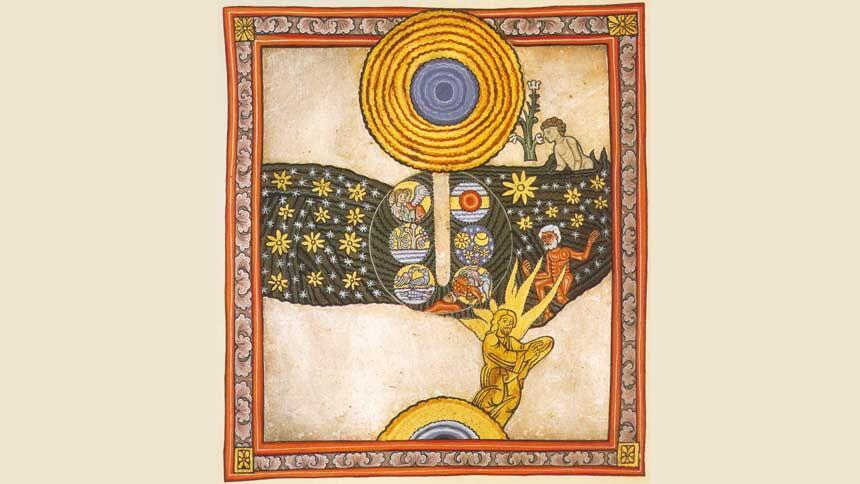
Later, he returned to the monastery and encountered the work of Hildegard of Bingen (1098-1179), a 12th-century figure whose thinking on medicinal plants, the human body, and mystical vision engages with and reorganizes the relationship between science, faith, and healing.
Decades later, this sensory experience would give shape to one of the most significant manifestations of the 61st Venice Art Biennale , La Biennale — the Holy See 's pavilion named L'orecchio è l'occhio dell'anima (“The ear is the eye of the soul”).
Hildegard was canonized in 2012 by Pope Benedict XVI and also proclaimed a "Doctor of the Church," reinforcing her theological and intellectual relevance. Her presence, however, transcends the religious sphere and serves as a key to understanding the present, inspiring the Vatican 's space in Venice.
Between politics, spirituality, and technology, the pavilion is organized as an exercise in attentiveness, echoing the words of Pope Leo XIV , who insisted on the need to relearn how to listen.
In the material distributed to journalists, the Holy Father summarizes this idea by stating that "the logic of the algorithm tends to repeat what works, but art opens up what is possible." Here, it is not a metaphor, but a method.
And when the invitation came from the Portuguese Cardinal José Tolentino de Mendonça, of the Dicastery for Culture and Education of the Holy See, to create something, Obrist returned to the theme of his childhood and had the opportunity to create his second project with the Vatican. “It was a perfect fit. We hit the nail on the head,” he says. The result is the padiglione at the Venice Biennale.
The Holy See has participated in the event since 2013. It is a way of bringing the Church closer to contemporary cultural debate. In 2025, for example, under Mendonça's coordination, the Conciliazione 5 exhibition space was inaugurated in Rome .
Initiatives like these keep alive the Church's relationship with the creative universe, a relationship that has spanned centuries and profoundly marked art in the West. From cathedrals, frescoes, and Renaissance sculptures to grand commissions from popes to artists such as Michelangelo and Gian Lorenzo Bernini, beauty has always been understood by the Vatican as a form of spiritual expression and a way of connecting with the divine.
Outside, noise.
In this year's edition of the Biennale, the Holy See's exhibition takes place in the Mystic Garden of the Discalced Carmelites, a historic spiritual retreat located next to the city's main train station.
The visitor enters, puts on headphones, and takes a contemplative walk, away from the hustle and bustle of tourists, listening to the 24 artists invited to create works that explore contemplative listening and silence. Among them are Brian Eno, Patti Smith, Suzanne Ciani, Meredith Monk, Jim Jarmusch, and FKA Twigs. A much-needed respite amidst the chaos of the Italian city.
According to the organization, this collection of recordings may, in the future, be released on vinyl, extending the project's life beyond the exhibition period — which ends on November 22nd.

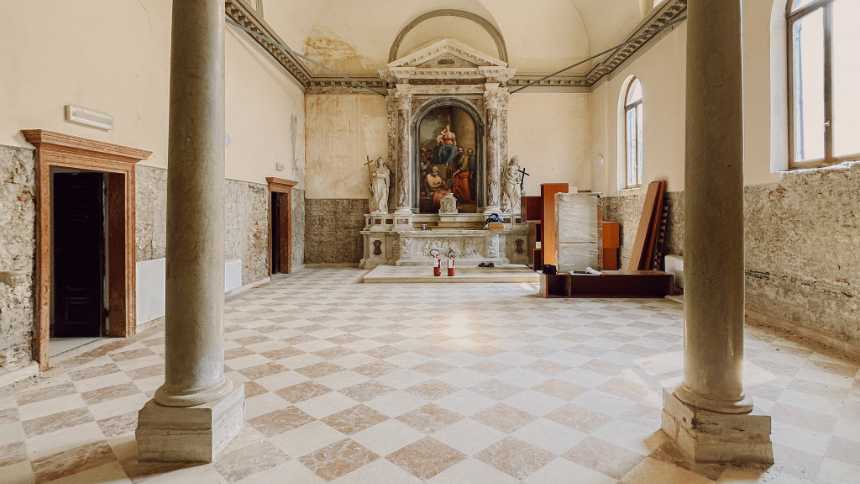
Also as part of the Holy See pavilion, the former Santa Maria Ausiliatrice Complex has been converted into a contemporary scriptorium — the place in medieval monasteries dedicated to the production of knowledge.
The space brings together a living archive inspired by Hildegard's thought, featuring manuscripts, art books, and a multilingual library. There is also a sound liturgy produced by the German nuns of Eibingen Abbey, the Benedictine monastery founded by the saint in 1165.
Three rooms in the complex house the last work of filmmaker and writer Alexander Kluge, one of the most important theorists ofpost-war German culture, to whom the pavilion owes its name. The installation of films and images, divided into twelve stations, was completed shortly before his death last March.
The relatively quiet atmosphere of the Holy See's spaces contrasts sharply with the turbulent atmosphere of the Biennale. The jury for the awards resigned just days before the opening, in protest against the simultaneous presence of Russia and Israel in the exhibition, exposing the political fissures that run through the art world and its institutions.
More than a one-off disagreement, the gesture highlights the growing difficulty in separating artistic production from geopolitical disputes, transforming the curatorial structure itself into a field of symbolic tension.
On opening day, April 6th, the punk collective Pussy Riot staged a demonstration in front of the Russian pavilion, shifting the exhibition's logic to a public arena. The event attracted visitors who took selfies with the protest in the background, while others circulated with glasses of champagne.
In this context, the Biennial's theme, In Minor Keys , proposes a subtle reflection. In music, "in minor keys" evokes a more intimate, introspective, and restrained perception of the world. The idea was conceived by Koyo Kouoh from Cameroon, the first African woman chosen as the artistic director of the event, who died in 2025, shortly before officially presenting her curatorial project.
Thus, the event shifts the focus from visual excess to the dimension of pause and resonance, in dialogue with the Vatican, which also bets on an immersive experience. In this intersection, a less strident space opens up, where what matters is what remains in echo.