

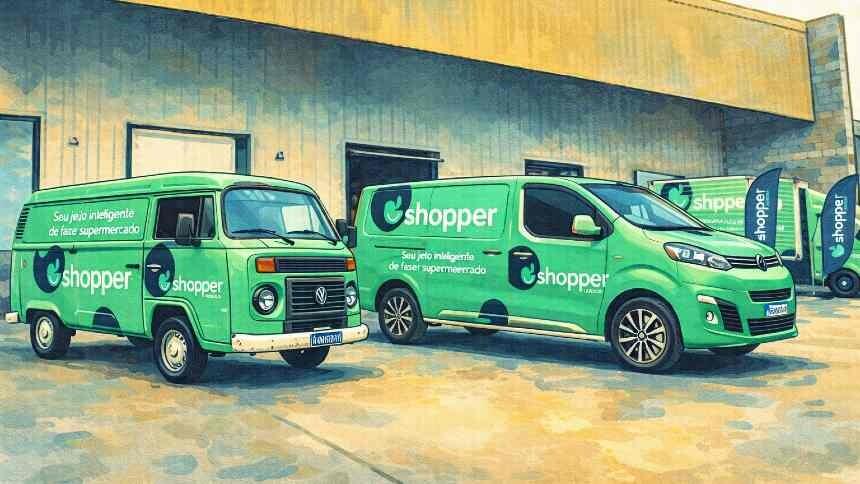

Shopper is accelerating its focus on fast deliveries, those made in up to 20 minutes, in a move to compete with Zé Delivery (Ambev) , Rappi , and Daki .
After operating exclusively within the iFood app, which holds a minority stake in the company , the service is now also available on the retailer's own app. This move is accompanied by a plan to invest R$ 100 million to expand the operation beyond the city of São Paulo and broaden its reach throughout the state.
The strategy aims to increase Shopper Now's weight in the company's results and contribute to the goal of reaching R$ 2 billion in revenue by 2027. "We believe the service can account for 20% to 25% of our business in a year and a half," says Fábio Rodas, co-founder and CEO of Shopper.
Launched as a pilot program in July with just one dark store, Shopper Now emerged to fill a gap between the two models already offered by the company: scheduled purchases, with monthly, bi-weekly, or weekly frequency; and one-off purchases, delivered on the same day, but with a minimum lead time of two hours.
Today, Shopper operates 13 dark stores in São Paulo, Campinas, and São Caetano do Sul. The plan is to almost quadruple that number by the end of the year, opening at least 30 new units and expanding the coverage of its express delivery service in the state.
According to Rodas, one of the reasons for the expansion is that the service has also proven to be an efficient channel for acquiring customers. Without disclosing numbers, the executive says that the company has observed a migration of these consumers to the platform's other services.
“Shopper Now has become a gateway for customers to try Shopper and then move on to shopping in a more planned way,” says Rodas.
With these initial results, the company feels ready to gain market share. And a significant part of this expansion involves giving more prominence to the beverage category, which already has strong demand and should gain even more traction with the World Cup .
Since the start of the pilot program, chilled beverages — both alcoholic and non-alcoholic — have been the fastest-growing category among the 3,000 available items. In May, the segment recorded a 100.7% year-on-year increase in revenue, while Shopper as a whole grew by 70%.
“We saw that some people were frequently using the service to buy drinks on various occasions, and now we want to expand this offering so that more people can learn about and start using the platform,” says Rodas.
The category will gain a dedicated space within the app, with an expanded assortment, but will continue to use Shopper Now's logistics infrastructure.
The company also wants to leverage this segment to meet the demands of social events — barbecues, gatherings, and pre-parties — offering everything from chilled picanha steak to plastic cups and bottle openers. The idea is to differentiate itself from services like Zé Delivery, which is more focused exclusively on beverages.
Shopper's more robust entry into this market comes at a time when platforms like Rappi and Daki already offer the service.
Even with major investors — GIC, Minerva, Quartz (which counts José Galló as one of its main investors) and iFood itself — the company chose to postpone its launch. The internal assessment was that, to succeed, it needed to be operationally "well-rounded," given the complexity of the model.
“The express delivery model has existed since 2015 and was already on our radar, but we understand that, among all the modes, it is the most inefficient, in the sense that there is a lot of idle capacity. To make a delivery in 15 minutes, you need to have people in a dark store waiting for the order to happen. If we had started with this model, we would have had to use a lot of capital,” explains Rodas.
For him, this patience was crucial to keeping the company competitive in a market that has already brought down players like Trela and Justo and caused Daki to lose its unicorn status .