

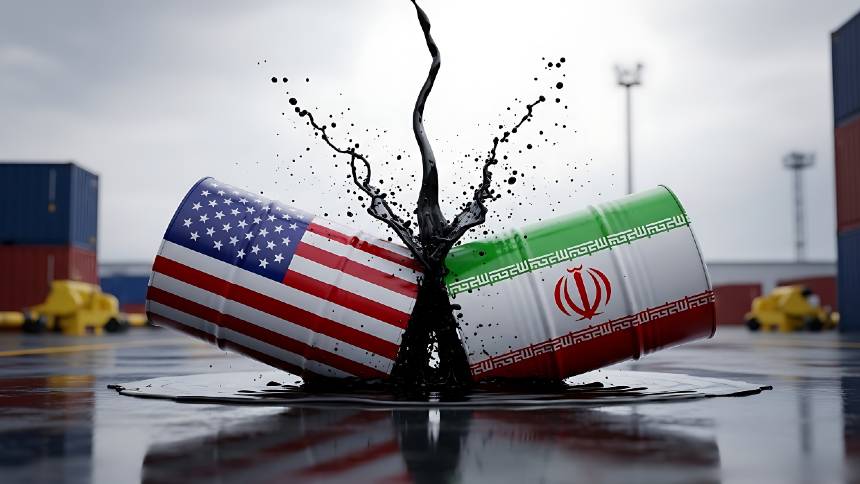
More than 100 days after the start of the war between the United States and Iran , and amid daily frustrated expectations for a definitive agreement to end the conflict, the apparent calm in the international oil market hides an increasingly fragile reality.
The stability of prices, below the US$100 per barrel mark — which surprised analysts and avoided an immediate energy shock, contradicting the US$200 per barrel forecasts made in March when the war began — is not due to normal supply, but to a combination of emergency measures that are already beginning to lose momentum.
And it is precisely this accelerated depletion of global oil reserves that creates the hidden factor behind President Donald Trump's haste in reaching an agreement with Iran.
The dominant narrative in the United States attributes Trump's urgency to domestic election pressure – expensive fuel is toxic for any government in a presidential election year. But the numbers show there's something deeper at play.
The world is consuming its strategic reserves at an unprecedented rate, and the ability to continue compensating for the loss of 15 million barrels per day—a direct result of the closure of the Strait of Hormuz—is reaching its limit. Global oil consumption is around 100 million barrels per day.
“With the blockage in the Strait of Hormuz and the reduction of reserves, the world is running out of shock absorbers,” says Antoine Halff, former chief analyst at the IEA.
For now, markets have only avoided an explosive jump in the price of oil because they have found ways to circumvent the disruption in the Persian Gulf region. China, for example, has reduced its imports by about 5 million barrels per day compared to the pre-war period, easing global demand.
Other countries, under pressure, also reduced consumption, especially in Asia - with 15 countries seeking emergency loans to contain the effects of the oil and natural gas shortage and adopting measures such as encouraging remote work and reducing working hours.
But the decisive element was the massive use of strategic reserves. In March, the 32 countries of the International Energy Agency (IEA) announced the largest coordinated release of stocks in history: 400 million barrels. Almost half of that volume has already been delivered, at a record rate of 2.5 to 3 million barrels per day.
This extraordinary flow acted as a global buffer. However, it is about to decrease drastically. Morgan Stanley estimates that releases could fall from 2.5 million barrels/day in June to just 0.7 million in July. If this happens, the market will face an immediate shock—unless the Strait of Hormuz is reopened.
Japan and the US on the brink.
Japan, which received 90% of its oil from the Middle East before the war, was the country that most strongly pushed for the coordinated release of oil from the IEA. The Japanese government announced it would put the equivalent of 50 days of consumption, or 90 million barrels, on the market. The initial rate exceeded 1 million barrels per day before falling to 600,000.
Even so, Japan still maintains public reserves for more than 120 days, above the minimum required by the IEA. The country has managed to replace some of its imports via Hormuz with oil transported by pipelines and purchases from producers outside the Gulf, especially the United States.
But it is precisely in the US that the situation becomes most critical. The American Strategic Petroleum Reserve (SPR) entered the war already weakened, after large withdrawals in 2022 and 2023.
It is now poised to hit its lowest level since 1983, according to The New York Times , amid a withdrawal of 172 million barrels, one of the largest in its history.
This will leave the reserve, a collection of salt caves in Texas and Louisiana, emptier than it has been in nearly half a century, since shortly after the 1970s oil crisis, when it was first being filled.
The government, concerned about the speed of the depletion, began lending oil instead of selling it—demanding repayment with a premium of 17% to 26% by 2029. Even so, 45 million barrels authorized for release remain without any interested buyers.
The situation is so delicate that three of the four auction rounds were partially empty. And, even before delivering the entire volume promised to the IEA, American inventories have already fallen to their lowest level since the 1980s.
Gasoline and fuel oil inventories are also dangerously low for this time of year in the Northern Hemisphere. Countries highly dependent on imports—such as Japan and South Korea—are already experiencing accelerated declines. In the US, regions like the East Coast and California are particularly vulnerable to sharp price increases.
There is no widespread shortage yet, but analysts agree that the risk grows each week. And, without a diplomatic solution, the market could face an unpredictable breaking point.
“There are several bottlenecks, and it’s really difficult to predict which one might emerge first,” says Daniel Sternoff, senior fellow at Columbia University’s Center on Global Energy Policy.
To understand why, one only needs to look at aviation fuel. At the beginning of the war, many analysts and executives feared that some airports in Europe, which buy a lot of aviation fuel from the Persian Gulf, might not have enough for takeoffs. Refineries, which transform petroleum into fuels, responded to the high prices by increasing the production of aviation fuel and reducing the production of gasoline.
If the price of oil hasn't soared beyond the initial peaks of the war, that's largely due to China. The reduction of 5 million barrels per day in Chinese imports acted as a kind of global "escape valve." By consuming less, China prevented demand from putting even more pressure on prices.
But this strategy has limits. China can reduce purchases, but it cannot indefinitely replace the oil that has stopped circulating through Hormuz. And if it decides to return to importing at normal levels, the global market will face an immediate shock.
Trump under pressure
Electoral pressure exists, but it's not the determining factor. What really puts Trump against the clock is the simple math of global reserves.
If the flow of oil through the Strait of Hormuz is not resumed quickly, the strategic reserves of rich countries will be depleted at an accelerated rate; the US will lose its last line of energy defense; the global market will be unable to absorb new shocks and prices will rise even before any physical shortage occurs.
This explains why the American president has repeated more than 30 times in recent weeks that a peace agreement was close, although this has always been subsequently denied by Iranian authorities.
On Friday, June 12th, the American press once again speculated about advanced negotiations aimed at ending the conflict.
According to the Axios website, citing an American diplomat, the terms of the agreement are already defined: the Strait of Hormuz should be reopened immediately without toll charges, and Iran will receive relief from sanctions upon compliance with the rules. The ceasefire will be extended for another 60 days, during which time the two countries will negotiate the Iranian nuclear program.
The recent drop in the price of oil to below $90 a barrel — after Trump once again stated that a deal with Iran was "imminent" — shows the level of market expectation. But it also reveals the risk: if the negotiation fails, the reaction could be violent.
In other words, the world is not yet out of oil. But it's running out of time.