

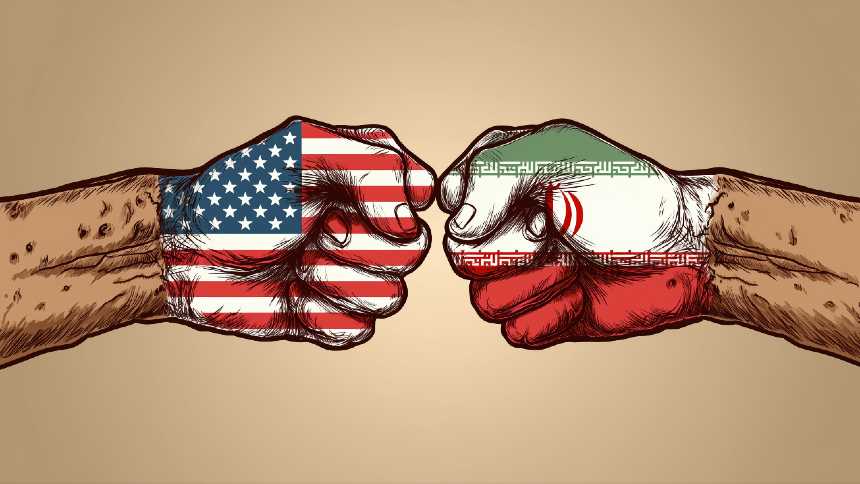
Global markets woke in euphoria on Monday, June 15, after the United States and Iran announced the previous night an initial agreement to end the war that has lasted more than one hundred days and gradually reopen the Strait of Hormuz .
The agreement, which is expected to be officially signed on Friday, June 19, in Switzerland, was enough to unleash a wave of risk appetite that had been pent up since the beginning of the conflict in February, and which is now spreading across stocks, commodities, and sovereign bonds.
Oil, the most sensitive barometer of the crisis, reacted immediately. Brent crude fell almost 5%, trading around US$83, giving back some of the gains that had taken the barrel above US$108 at the height of the tensions—still below, however, the feared US$200 that analysts had projected as an extreme scenario.
The mere prospect of reopening the strait, responsible for about 20% of the global oil flow, was enough to ease the market, which was already beginning to price in a real risk of shortages.
The reaction quickly spread to stock indices. Nasdaq and S&P 500 futures rose 2% and 1.2%, respectively, before the opening in New York. In Europe, the Stoxx 600 recovered losses accumulated since the beginning of the war and renewed its all-time high, while the Nikkei 225 jumped 5% in Tokyo, also hitting a record high.
The movement reflects a clear interpretation: if oil prices lose pressure, global inflation breathes – and, with it, the expectation of interest rate cuts returns to the radar.
“From a market perspective, a deal is clearly positive,” Mohit Kumar, chief economist for Europe at Jefferies, told the Financial Times. This statement summarizes the prevailing sentiment among investors who, in recent weeks, have been reducing their risk exposure in the face of the toxic combination of prolonged conflict, expensive energy, and still cautious central banks.
But, as always, the devil is in the details. And, in this case, in the details that don't yet exist. The final document of the agreement has not been released, and the versions presented by Washington and Tehran leave more questions than answers.
Trump celebrated the reopening of the Strait of Hormuz "for mine removal purposes," stating that oil "will flow again in both directions." Meanwhile, Iran's Supreme National Security Council declared that the war "ends permanently and immediately on all fronts, including in Lebanon." However, the scope of this promise is viewed with skepticism by European diplomats.
There are significant doubts regarding the implementation of the ceasefire. The first of these is logistical: even with the agreement signed, mine removal, route reorganization, and the normalization of maritime insurance could take weeks.
The second is political: Israel, which is not a party to the agreement, maintains military operations in sensitive areas and has already signaled that it does not intend to back down. Any regional escalation could jeopardize the truce before it even comes into effect.
The third – and most sensitive – issue involves the Iranian nuclear program. Iran possesses more than 9,000 kg of enriched uranium, of which approximately 440 kg are close to the level required for military use.
The agreement provides for 60 days of negotiations to determine the fate of this stockpile, but there is no consensus on what this means in practice. Washington speaks of "disposing of" the material; Tehran insists it will not relinquish its right to enrich uranium for civilian purposes. This is the kind of ambiguity that often erodes agreements before they mature.
Still, for the US, the announcement comes at a good time. The government feared that the continuation of the conflict would further pressure energy prices, contaminating inflation and, consequently, the mood of the electorate in an election year. The drop in oil prices on Monday is, therefore, more than an economic relief – it's a political breather.
Qatar and Pakistan, mediators in the process, say that a series of technical meetings will take place throughout the week to prepare for the signing ceremony. But until then, the market will continue to operate between immediate relief and structural caution.
This morning's euphoria shows what's at stake: if the agreement succeeds, the normalization of energy flow could redefine global sentiment in the second half of the year. If it fails, volatility returns with a vengeance.