

Brasilia - In October 2023, the Minister of Planning, Simone Tebet, had her first and only exclusive meeting with President Luiz Inácio Lula da Silva to discuss specific projects related to her ministry.
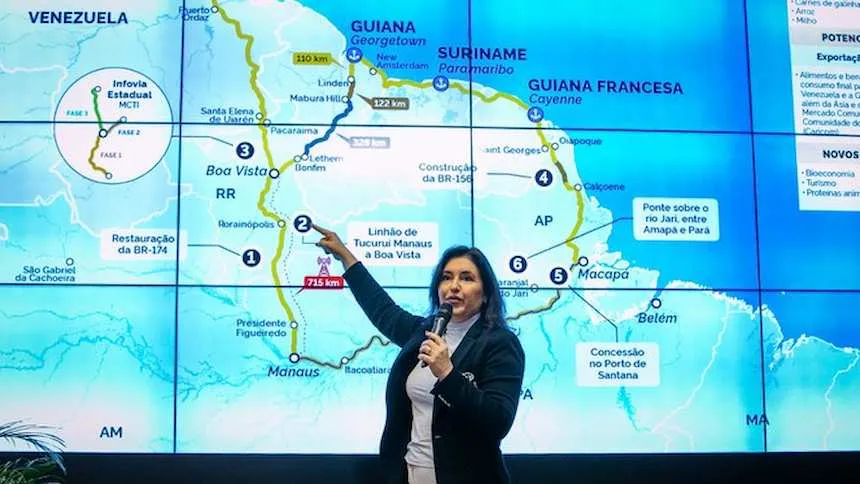
He brought with him a project that was, until then, controversial and costly, the "South American Integration Routes," which, through five multimodal axes, connects 11 Brazilian states to 12 countries. Lula liked the idea and asked for some minor adjustments.
From October 2023 to February 2025, the program, according to exclusive figures obtained by NeoFeed , secured R$ 25.9 billion from the PAC 2024, the 2025 budget, and the National Development Bank (BNDES).
Another US$7 billion will be allocated to neighboring countries through financing from the Inter-American Development Bank (IDB), the Development Bank of Latin America (CAF), and the Financial Fund for the Development of the River Plate Basin (Fonplata).
On March 16th, one of the initial milestones of the project, as envisioned by the technicians at the Ministry of Planning, will be realized: the inauguration of the port of Chancay, in Peru, which is expected to serve as a route for Brazilian products to Asian countries, mainly China.
The controversial route equation is one of the difficulties , as reported by NeoFeed last November. However, the resources made available so far and the project's management itself have encouraged Minister Tebet.
Planning officials met in 2024 with representatives from border states and all the finance ministers of neighboring countries, with the exception of Venezuela – in this case, due to geopolitical reasons related to the suspicious election of Nicolás Maduro.
The Mercosur-European Union agreement, finalized last December, gave the project more momentum and brought greater optimism to Brazil. The trade war launched by US President Donald Trump exposed the need, according to Brazilian government experts, for a more direct link with Asia, starting from the port of Chancay.
The imminent opening of the Peruvian port, a mega-investment in partnership with China worth US$3.5 billion, promises to reduce shipping times from Latin American countries to Asia by 10 days.
The project is expected to be larger than the Port of Santos, with more advanced technology for ship berthing and distribution – including a 20-meter draft – as well as improved container handling and cargo storage. Furthermore, coastal shipping agreements have already been established with Bolivia, Chile, and Colombia, Peru's neighbors to the north and south.
“The 'Routes of Integration' is a legacy, something consistent to unite Latin American countries, which has an initial work date of May 30, 2023, and which has developed over the last few months,” says João Villaverde, Secretary of Institutional Articulation at the Ministry of Planning, to NeoFeed .
The five routes are comprised of waterways, highways, railways, ports and airports, as well as information highways (for the technological infrastructure). In total, the New PAC encompasses 190 initiatives for the "Routes," with values of R$ 4.1 billion.
“We formulated it based on the consensus reached in Brasília, which brought together all the presidents of all the South American countries here in Brasília. And then we updated the infrastructure issues to the infrastructure needs in partnership with the Civil House,” said Villaverde. The government also expects results in tourism, especially in business-related areas.
Mistrust
However, Brazilian businesspeople have reservations about the project's short-term viability. A NeoFeed report published in November highlighted a colossal logistical difficulty related to the port of Chancay.
It's an 800 km stretch of winding roads in the Andean part of the Interoceanic Highway to Tabatinga (AM), the first Brazilian city after the Peru/Colombia border. Then a long river journey to Manaus. The challenge for imported and exported cargo in Brazil, considering customs and security itself.
Cost and risk assessments are beginning to be carried out by Brazilian and neighboring countries' businesspeople. For the Lula government, which endorsed the Planning Ministry's project, the outcome will be favorable over time. Chacay, in any case, has arrived. Now, the question is how the "Routes" will be utilized.
One of the answers will be ready in the coming days. The Brazilian government commissioned a major study from the IDB to determine the impact that the actions of the Brazilian project will have on the Gross Domestic Product (GDP). We'll have to wait and see.