

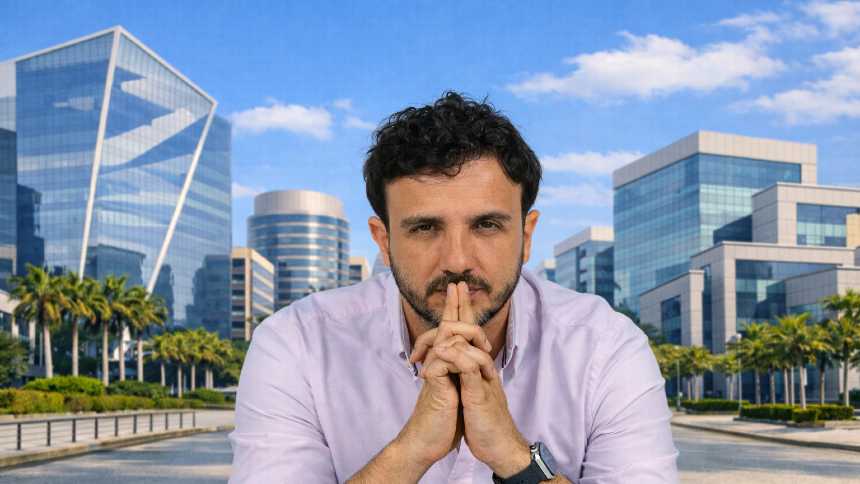
Amid Flávio Bolsonaro 's declining popularity in the presidential polls, a name previously off the radar has shown signs of emerging. Renan Santos, pre-candidate for Missão, a party of the Movimento Brasil Livre (MBL), appeared ahead of Ronaldo Caiado and Romeu Zema in a poll conducted by Quaest, released this Wednesday, June 10th.
He appears in third place, with 3% of voting intentions, tied with Caiado. Second-round scenarios indicate that Santos reached 31% of voting intentions in the contest with President Luiz Inácio Lula da Silva , his best performance in the historical series.
With these results in mind, Santos participated this Wednesday, June 10th, in an event promoted by Genial Investimentos with clients and partners in São Paulo, to talk about his visions for the country and how he will conduct his campaign, even without television time and infrastructure similar to those of his opponents.
In a meeting with members of the Faria Lima group, he criticized both Lula and Bolsonaro, demonstrating a certain misalignment with the market when the subject is privatization, criticizing what he called "liberal nonsense."
"The problem with liberalism in Brazil is what we've dubbed 'liberal nonsense,' something that emerged on social media and involves oversimplification for online debate," Renan stated.
He also highlighted that, among the alternative candidates, he is the only viable one, given his history with the MBL. "All the magazines were ignoring me, but they won't be able to take me out of the picture, because I'm going to win this thing," said Santos. "Naturally, I'm going to surpass these guys, because I'm a better leader than they are. I lead a political movement and I'm the president of a party."
According to him, his candidacy will only become truly competitive for everyone when he "finishes crossing the Rubicon," which means showing that he is the most viable option to defeat Senator Flávio Bolsonaro in the second round, paving the way for an alliance with some sectors of the right. "I need to prove myself so that I can be heard," he stated.
His strategy is to grow among younger, male audiences, where the MBL has greater penetration, move up the age pyramid to win over more women, and gain ground among voters who are not fully aligned with either Bolsonaro or Lula. "There are many more voters than they imagine, voters who are open to persuasion and to building a joint project," he said.
Despite analysts' assessment that Santos needs a share of Bolsonaro's votes if he goes to the second round, he did not go easy on the senator.
In the conversation, he attacked Flávio Bolsonaro and his relationship with former banker Daniel Vorcaro , as well as accusations that the senator has links to organized crime in Rio de Janeiro, stating that he is a "scandal machine".
When questioned about the possibility of losing votes, he said that "choosing the audience I don't want to convince says more" about his candidacy, also highlighting that it's impossible to avoid the subject.
"The voter who, in 2026, considers Flávio the courageous, ethical option, a guy who defended all that gang from Rio de Janeiro involved with Comando Vermelho, a guy who cannot be president of the Republic, whoever chooses that is wrong," he stated. "It's not my fault that he was associating with hitmen linked to illegal gambling bosses, it's not my fault, he forces me to speak. I don't say these things about Zema and Caiado."
Regarding Lula, he classified him, as well as the PT (Workers' Party), as his "historical enemies," recalling the MBL (Free Brazil Movement) era, when he helped orchestrate the impeachment of former president Dilma Rousseff . "My dedication is to confronting the PT. Unlike Flávio, who was involved in corruption, I was involved in destroying the PT. My greatest enemy is PT ideology," he said.
Like other right-wing candidates, Santos stated that the country will face a severe financial crisis if Lula is re-elected, considering the increase in spending. In this regard, he said he intends to implement a fiscal austerity agenda as soon as he is elected, ending indexation and cutting expenses.
He stated that he is inspired by Javier Milei , the president of Argentina, who was elected advocating a tough austerity agenda. "He demonstrated that electoral sincerity doesn't cost votes, because people understand when you say that more intensive measures are needed. We will implement a set of reforms right from the start and fight clearly, outlining the agenda we defend," he said.
Santos also pointed out that the country has some "shortcuts" that it can take advantage of to re-energize growth. One of them is the issue of essential minerals . According to him, it is necessary to have not only the extraction and refining chain, but also the businesses that will produce the final products within Brazil.
Another "shortcut" would come from the energy sector: leveraging Brazil's advantage of having abundant and cheap power generation to attract data centers .
Despite his liberal agenda, Santos has shown that he is not willing to privatize Petrobras , unlike what Zema has already indicated. For him, privatizations cannot be part of the fiscal agenda. He stated that this view is part of a current he classified as "liberal nonsense," characterized by simplifications aimed at online debates, a syndrome he has already suffered from.
"We've seen some really bad privatizations, like the case of Emae, and the purchases that [businessman Nelson] Tanure made in Paraná," he said. "Selling Petrobras is not fiscal policy. And, in a world of scarce strategic reserves, does it make sense to hand over an asset to a Saudi state-owned company? Regulatory frameworks are needed to avoid harm to shareholders. In the case of other state-owned companies, like the Post Office, it's okay to sell them."