



Finding future football stars before their professional careers or entry into the youth ranks of major clubs has always depended on the keen eye of scouts, recommendations, and tryouts spread across the country. However, the selection of athletes is gaining a new ally: artificial intelligence .
The startup Footbao is behind the project. The proposal is to create a kind of digital talent funnel. Through the app, players send videos of games and individual plays. From this material, the platform combines AI models , data analysis, and expert evaluation to identify athletes with potential and connect them with partner clubs.
With European roots, Footbao chose Brazil to kick things off. The decision stems from the size of the market, the country's strength as a breeding ground for players, and the difficulty clubs face in covering such a vast and fragmented territory with scouts.
The company was founded by Swiss national Francesco Amato, has British CEO Nick Rappolt, and among its main investors is Swiss-Italian Boris Collardi, former CEO of Julius Baer . Former footballer Denílson is also listed by the company as one of its financiers, alongside the coach of the Swiss national team, Murat Yakin, and Spaniard Alejandro Agag, founder of Formula E.
The platform brings together around 120,000 players. Of that total, 20,000 profiles have videos, 14,000 have been evaluated, and more than 300 have been recommended to partner clubs. The startup maintains relationships with more than 35 teams, including Palmeiras, Corinthians , São Paulo, Santos, Goiás, Avaí, and Lecce, from Italy.
“We have a mobile app that can scout at scale because we can cover all parts of Brazil. A club from Malaysia, China, the UK, or even Brazil can't do that because they don't have enough scouts,” says Nick Rappolt, CEO of Footbao, in an interview with NeoFeed .
Although AI scales the operation, Footbao still relies on an in-house team of analysts and talent scouts responsible for reviewing videos, validating assessments, and putting the finishing touches on technical reports that will be sent to clubs.
Among the gems discovered by the platform, highlights include 18-year-old midfielder Leonardo Veiga, recruited by Spezia in Italy after a spell at Lecce, and 16-year-old defender Gloria Gasparini, who was signed by Corinthians and called up to the Brazilian under-17 national team .
Although the initial recommendations are already yielding results, the current model is quite recent. The company emerged in 2023, but the focus on partnerships with professional clubs and talent scouting only began to take shape in 2025. Until then, Footbao functioned more as a social network for players to post videos of their skills.
“The mission has always been to find talent, but the business model of a ' TikTok for football' had some problems,” says Rappolt. “If you try to monetize purely through advertising, you compete with other social media platforms.”

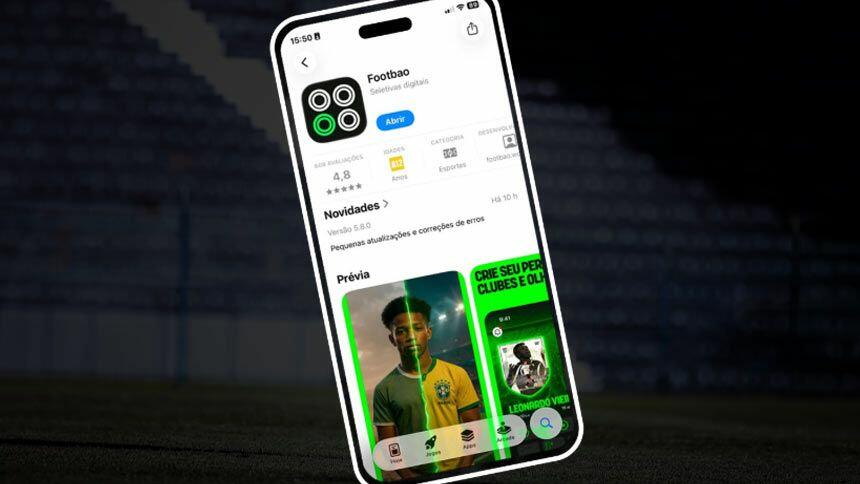
From the clubs' perspective, the system remains a partnership. Teams access the talent database and reports without direct charge and, in return, help promote Footbao on their social media channels. The logic is to leverage the strength of the clubs' brands to attract new players to the app and expand the funnel of evaluated athletes.
Access to the platform remains free, but there is a subscription for players who want access to additional features, such as individual reports, data on technical skills, and suggestions for improvement.
Monetization, however, should evolve as the marketplace gains scale. The company sees room to charge clubs and agents for services and, in the future, fees associated with the movement of players within the ecosystem.
According to Rappolt, short-term plans include expanding Footbao to other Latin American countries, such as Argentina, Uruguay, and Colombia, where the startup has established partnerships with local clubs. The idea is to replicate the model tested in Brazil in other talent-exporting markets, creating a regional base of athletes evaluated by the platform.
However, the ambition goes beyond scouting. Footbao wants to position itself as an infrastructure layer for football, connecting players, clubs, scouts, and agents. In the future, the company intends to add tools for contract management, image rights, and tracking the athletes' career paths.
One of the areas being studied is allowing fans, brands, or investors to participate, in some way, in the financial development of athletes discovered through the platform. Rappolt mentions the possibility of tokenizing players or contracts, creating instruments linked to future revenues.
“There’s a very strong emotional connection, as a fan, with an emerging talent,” says Rappolt. “You can tokenize a player who transfers to a club, or tokenize a player’s contract, so that people can participate in future revenue as he progresses through the system.”
The idea is still in the planning phase and would have to navigate sensitive terrain involving athletes' economic rights, contracts with minors, agents, clubs, and capital market regulation. However, the thesis suggests that Footbao aims to go beyond being a digital showcase for players and become an infrastructure for monitoring and monetizing the careers of talented individuals from the grassroots level.